| National Park Krka |
| National Park Krka is a spacious, largely unchanged region of exceptional and multifaceted natural value, and includes one or more preserved or insignificantly altered ecosystems. It is intended primarily for scientific, cultural, educational, recreational, and tourism activities such as visiting and sightseeing. It was proclaimed a national park in 1985. |
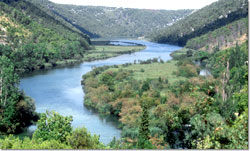 |
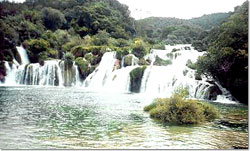
The Krka National Park is located entirely within the territory of Sibnik-Knin County and encompasses an area of 109 square kilometres along the Krka River: two kilometres downriver from Knin to Skradin and the lower part of the Cikola River. From the flooded part of the mouth, it is 72.5 kilometres in length, making the Krka the 22nd longest river in Croatia. The source of the Krka River is at the base of the Dinaric Mountains, 3.5 kilometres northeast of the base of Knin and 22 meters below Topoljski Slap, Veliki Buk and Krcic Slap, which are noisy cascades in the winter but run dry during the summer. The length of the freshwater section of the river is 49 kilometres and that of the brackish section is 23.5 kilometres. Significant tributaries of the Krka River include Krcic, Kosovcica, Orasnica, Butisnica and Cikola with Vrb. With its seven travertine waterfalls and a total drop of 242 meters, the Krka River is a natural and karstic phenomenon.
 |
The Krka National Park belongs to the Southern European (Mediterranean and sub-Mediterranean) region. Due to its special position and the mosaic distribution of various types of habitats, it is characterized by exceptionally rich and varied flora and fauna. Eight hundred and sixty species and subspecies of plants have been identified within the territory of the
Krka National Park, including several |
endemic Illyrian-Adriatic species. The wealth of plant species, where warm and dry habitats come into contact with moist and shady ones, are of particular interest at Roski Slap, with its canyon vegetation, and at Skradinski Buk, where you can see the plant species of the travertine barriers.
Eighteen species of fishes inhabit the Krka River, among which ten are endemic, making the Krka a natural landmark of the highest category. Patches of reeds, lakes formed along part of the river and swamped meadows abound in amphibians and birds, while thickets and stone quarries are home to reptiles. The abundance of various species of birds (222), the structure of the bird communities and the great significance of the Krka for spring and autumn migrations make it among the ornithologically most valuable regions of Europe. Among mammals, there are 18 species of bats, which are generally endangered or near extinction in the rest of Europe.